Changes to model timesteps#
It is not uncommon for the CAFE model to become unstable during a run. For most of the CAFE-f6 forecasts, the standard approach for resolving this issue was to restart the forecast with reduced model timesteps. There are three timesteps used by CAFE:
dt_atmos   <- the atmospheric component time step [s]
dt_ocean   <- the ocean component time step [s]
dt_cpld    <- the coupling time step [s]
Most CAFE-f6 runs use the default values of dt_atmos = 1800, dt_ocean = 1800, dt_cpld = 1800 (see https://github.com/csiro-dcfp/cm-forecasts/blob/ccf838e5d1ac7f71c63cda6a43e5eee5280fff4c/settings.sh#L116). However, some runs that fell over were rerun with dt_atmos = 1200, dt_ocean = 1200, dt_cpld = 1200 or even dt_atmos = 900, dt_ocean = 900, dt_cpld = 900 if that was also unsuccessful.
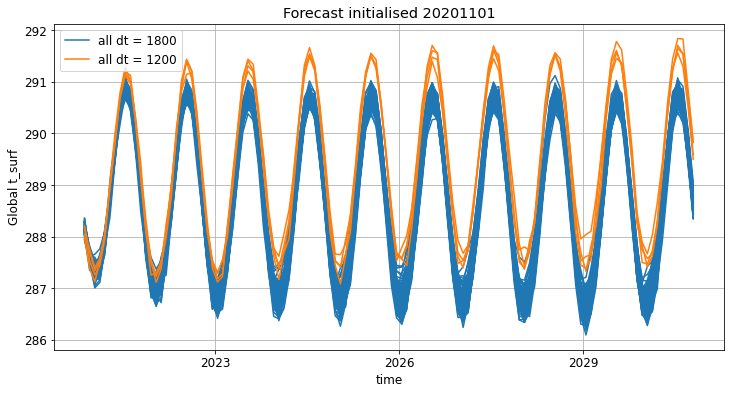
It was subsequently discovered that adjusting dt_atmos can substantially affect the free-running attractor of the model, see https://github.com/dougiesquire/cm-historical/blob/0d7c4601592b5b337d77f3c04228f1a0f67d76c2/notebooks/hist_mem001.ipynb. This is very evident in the forecast members that were run with a reduced atmospheric time step.
(Note that some of the files linked on this page are only accessible by members of the CSIRO DCFP Github organisation. These links are included for tracebility. Any relevant lines from linked files have also been copied to this page.)
[1]:
import xarray as xr

import matplotlib.pyplot as plt

plt.rcParams["figure.figsize"] = (12, 6)
plt.rcParams["font.size"] = 12
[3]:
data_dir = "../data/raw/CAFEf6/c5-d60-pX-f6-20201101/"
file = f"{data_dir}/atmos_isobaric_month.zarr.zip"

ds = xr.open_zarr(
    f"{data_dir}/atmos_isobaric_month.zarr.zip",
)["t_surf"]

ds_gbl = ds.weighted(ds["area"]).mean(["lat", "lon"]).compute()
[4]:
reduced_dt_ensembles = [27, 37, 51, 76]
ds_reduced_dt = ds_gbl.sel(ensemble=reduced_dt_ensembles)
ds_default_dt = ds_gbl.sel(
    ensemble=list(set(ds_gbl.ensemble.values) - set(reduced_dt_ensembles))
)

p0 = ds_default_dt.plot.line(x="time", add_legend=False, color="C0")
p1 = ds_reduced_dt.plot.line(x="time", add_legend=False, color="C1")
plt.ylabel(f"Global {ds_default_dt.name}")
plt.grid()
plt.title(f"Forecast initialised {data_dir.split('/')[-2][-8:]}")
_ = plt.legend([p0[0], p1[0]], ["all dt = 1800", "all dt = 1200"])
Masking based on timestep#
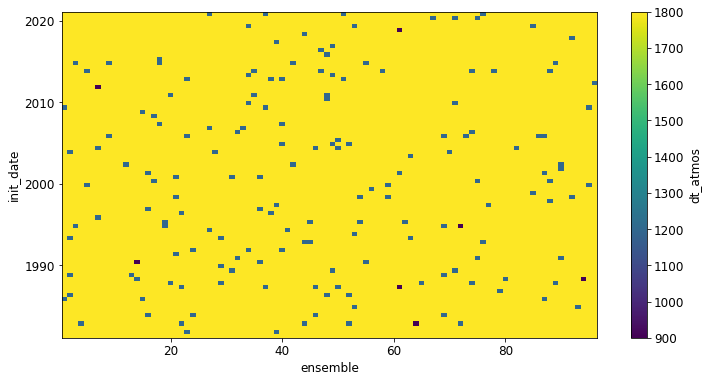
A mask has been generated for the forecasts that were run at a reduced timestep so that these forecasts can be readily removed prior to analysis. The mask is available with the raw CAFE-f6 data.
[5]:
dt_mask = xr.open_dataset("../data/raw/CAFEf6/CAFE-f6_dt_atmos.nc")["dt_atmos"]
dt_mask.plot()

reduced_dt = xr.where(dt_mask < 1800, 1, 0)
print(
    (
        f"The total number of forecasts run with reduce dt_atmos is {reduced_dt.sum().values},"
        f" which is {100 * reduced_dt.mean().values}% of the CAFE-f6 dataset"
    )
)
The total number of forecasts run with reduce dt_atmos is 172, which is 2.2395833333333335% of the CAFE-f6 dataset
Note that moving forward, users of the CAFE system can change dt_ocean without (obviously) effecting the free-running attractor of CAFE (see https://github.com/dougiesquire/cm-historical/blob/0d7c4601592b5b337d77f3c04228f1a0f67d76c2/notebooks/hist_mem001.ipynb). All unstable CAFE runs since discovering this issue were rerun with dt_atmos = 1800, dt_ocean = 900, dt_cpld = 1800.